
Nimmadhi Property Management Alternative: 6 Chennai Companies Compared (2026)
Property Management
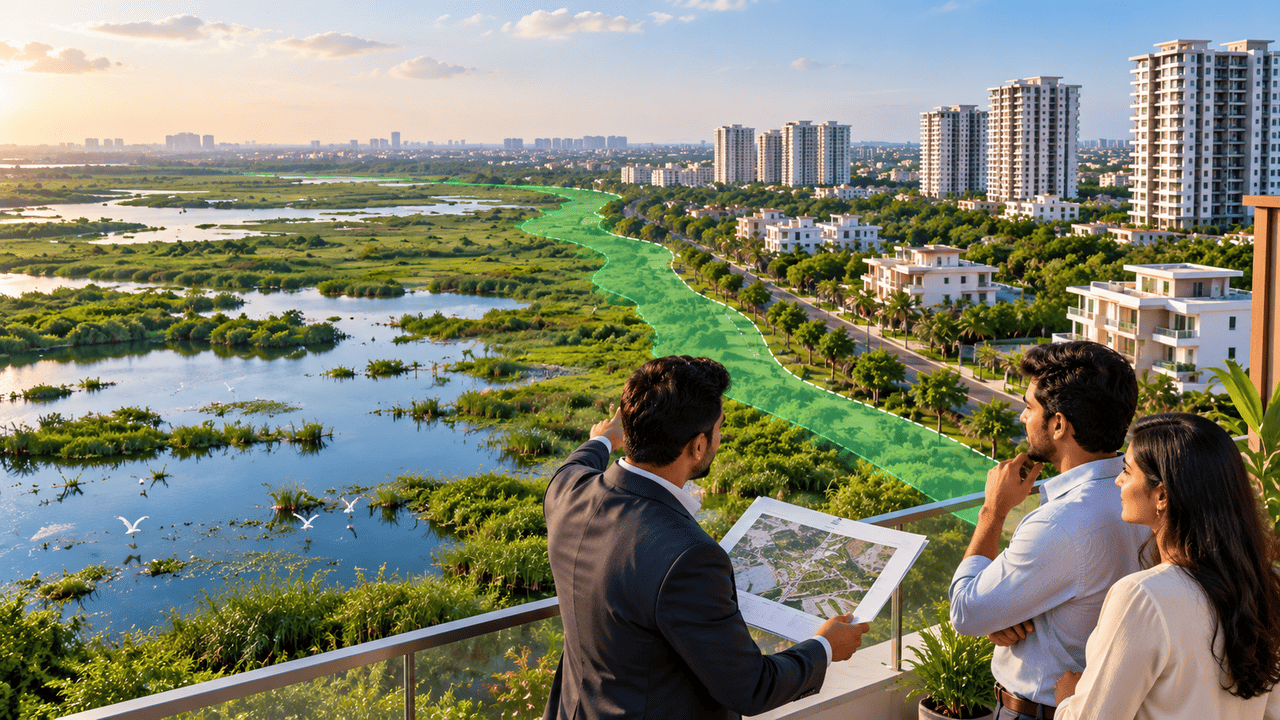
Pallikaranai marshland buffer zone: What it means for property owners and buyers in south chennai
A construction freeze tied to the Pallikaranai marshland is affecting Velachery, Sholinganallur, Perumbakkam, and Medavakkam, and the final boundary is still being decided in the Madras High Court. Here’s what’s confirmed, what’s not, and what it means for your property.

What is the pallikaranai marsh, and why does it matter legally
Pallikaranai Marsh is Chennai’s last major natural wetland, and ithas shrunk dramatically over the decades. It originally covered roughly 5,000hectares in the 1960s; through decades of urban expansion, road and rail construction, and waste dumping, it has shrunk to around 650 to 700 hectares today, a loss of close to 90 percent of its original area. In recognition of what remains, the Government of India declared Pallikaranai Marsh a Ramsar site, a wetland of international importance, in 2022, with part of the area,317 hectares, already declared Reserve Forest back in 2007. That legal status is the foundation for everything that has followed.
The NGT order and the construction freeze
In September 2025, the National Green Tribunal’s Southern Bench ordered that no new construction approvals be granted within a 1 kilometer buffer of the marsh, pending a scientific study to properly define the area sactual zone of ecological influence. Acting on that order, the Chennai Metropolitan Development Authority issued a formal office order on October 9,2025, freezing building plan approvals across a wide stretch of South Chennai, reported at roughly 8,500 acres, touching localities including Pallikaranai,Perumbakkam, Sholinganallur, Medavakkam, Velachery, Perungudi, Okkiyam Thoraipakkam, Karapakkam, Injambakkam, Seevaram, Kulathur, and Madipakkam. Ifyou own land or a home in any of these areas, this freeze is directly relevantto you, whether or not your own plot is near the visible wetland itself.
The legal pushback: CREDAI’s case in the madras high court
The construction freeze did not go unchallenged. In early 2026, the Confederation of Real Estate Developers’ Associations of India, CREDAI, Chennai chapter, along with individual realtors, filed petitions in the Madras High Court arguing that a blanket 1 kilometer freeze across such a large area is disproportionate and should be narrowed or replaced with a more targeted boundary. The Tamil Nadu State Wetland Authority has told the court that construction in the area can be regulated rather than banned outright, and has submitted a revised buffer proposal based on actualhy drology, drainage patterns, and elevation, rather than a uniform circular radius. As of the most recent scheduled hearing on September 7, 2026, the court had not issued a final ruling, and the matter remains actively pending. This means the exact boundary that will ultimately apply is still not settled, and anyone transacting in the area should confirm the current status before finalizing a decision rather than relying on this article’s snapshot of an evolving situation.

What this means if you already own property there
For existing owners, the most immediate concern is what happens to routine maintenance and renovation. Residents in affected localities have reported that even ordinary repairs and structural renovations now require explicit permission that wasn’t previously needed, creating real uncertainty for people who simply want to maintain a home they’ve owned for years. Over 300residents protested this in January 2026, arguing that previously approved, legitimately purchased housing is being caught up in restrictions aimed at preventing new illegal construction. If your building approval predates October9, 2025, it is generally understood to remain valid, but any renovation, extension, or structural work going forward may need to be checked against the current CMDA position before you start, not after.
What this means if you’re buying in the area right now
If you’re considering a purchase anywhere in Pallikaranai,Perumbakkam, Sholinganallur, Medavakkam, Velachery, Perungudi, or the surrounding OMR-adjacent localities, treat this as a mandatory part of your due diligence, not an afterthought.
At minimum, confirm the exact survey number of the property and check it against the government’s own wetland and buffer zone records rather than relying on a seller’s or broker’s assurance.
Internal link suggestion: link “confirm the exact survey number” to the blog post “How to Verify Property Title and Avoid Legal Disputes in Chennai.” Separately from the wider 1 kilometer buffer under review, the Tamil Nadu State Wetland Authority has already identified a more specific list of survey numbers, reported at around 304parcels, that fall inside the actual Ramsar core boundary itself, where there strictions are considerably stricter and better established than the still-contested outer buffer. Ask for the exact date the building plan was approved, since that single date currently determines whether an approval is considered valid or frozen. If the project has environmental clearance, verify it independently rather than taking a brochure’s word for it. And be direct with your bank about the property’s location before assuming a home loan will be approved without friction, since lenders have become noticeably more cautious about financing property in and around the buffer zone.
Why resale and financing are already being affected
Even before a final court ruling, uncertainty of this scale tends to show up in prices and financing before it shows up in headlines. Property in and around the buffer zone has reportedly seen resale hesitancy, and banks are approaching loan applications in the area with additional caution. This doesn’t mean property in these localities is unsellable or unfinanceable, plenty of transactions are still happening, but it does mean sellers and buyers a like should expect more scrutiny, more documentation requests, and potentially longer timelines until the legal boundary is finally settled.

A note on what’s still genuinely uncertain
It’s worth being direct about the limits of what’s currently known. The exact final boundary of the buffer zone has not been legally settled. The distinction between the stricter Ramsar core, the roughly 304 identified survey numbers, and the wider, still-contested 1 kilometer influence zone matters enormously for any specific property, and that distinction is easy to blur in casual conversation or a seller’s pitch. Numbers reported across different sources for the exact acreage and number of affected localities vary some what, a reflection of how fluid this situation still is. Nothing in this article should be treated as a final legal determination for any specific plot. If a transaction of real consequence depends on this, verify the current position directly with CMDA or a qualified legal advisor before you sign anything.
How RAPRO helps
RAPRO has operated in Chennai for over30 years, serving 1,000+ property owners with a 4.8 star rating across 415+reviews. For anyone owning or buying property in the South Chennai localities affected by the Pallikaranai buffer zone situation, RAPRO can verify survey numbers, approval dates, and documentation on the ground, so you’re making a decision based on facts rather than a broker’s assurance.

FAQ
Frequently asked questions
Everything you need to know about our consulting and AI solutions — from strategy to implementation.
Should I avoid buying property in Sholinganallur, Perumbakkam, or nearby areas entirely?

Is this freeze permanent?
How do I find out if my specific property is inside the restricted zone?
Does the Pallikaranai buffer zone freeze mean I can’t sell my property