

Top 10 Commercial Property Consultants in Chennai (2026)
Property Management
How to Obtain an Encumbrance Certificate in Chennai (2026)
An encumbrance certificate shows every registered sale, loan and claim on a property. Learn how to get one online on TNREGINET or offline at the Sub Registrar Office, which period to ask for, and how to read it, with a free EC request planner.

If you are buying, selling or borrowing against property in Chennai, sooner or later someone will ask for an Encumbrance Certificate (EC), commonly known as a Villangam Certificate in Tamil Nadu. Banks want it before they approve a home loan. Lawyers want it before they give a title opinion. Buyers want it before they pay an advance. And yet many people only find out what an encumbrance certificate actually is when a deal is already waiting on it.
The good news is that in Tamil Nadu you can get most of it online in a few minutes, provided you have the right details to hand. This guide explains how to obtain an encumbrance certificate in Chennai, online and at the Sub Registrar Office, which period to ask for, and, just as important, how to read it once you have it.
What is an Encumbrance Certificate (Villangam Certificate)?
An encumbrance is any claim or charge on a property: a mortgage, a lease, a court attachment or a sale. An encumbrance certificate is the Registration Department's record of every such transaction registered against a property over the period you ask for. Think of it as the property's registered history, in one document.
That history matters because it lets you check what the seller has told you. If the seller says the property has never been mortgaged, the EC will show whether that is true. If the chain of title says the property was sold in 2004 and again in 2012, those sales should appear on the EC. And if a loan was taken, you should see it released before you buy.
EC Forms in Tamil Nadu
In Tamil Nadu the EC process uses three forms. You apply on Form 22 when going to the Sub Registrar Office. What you receive is either Form 15, which lists the transactions found, or Form 16, a nil encumbrance certificate, which confirms that no transaction was registered during the period.
How to Obtain a Villangam Certificate Online
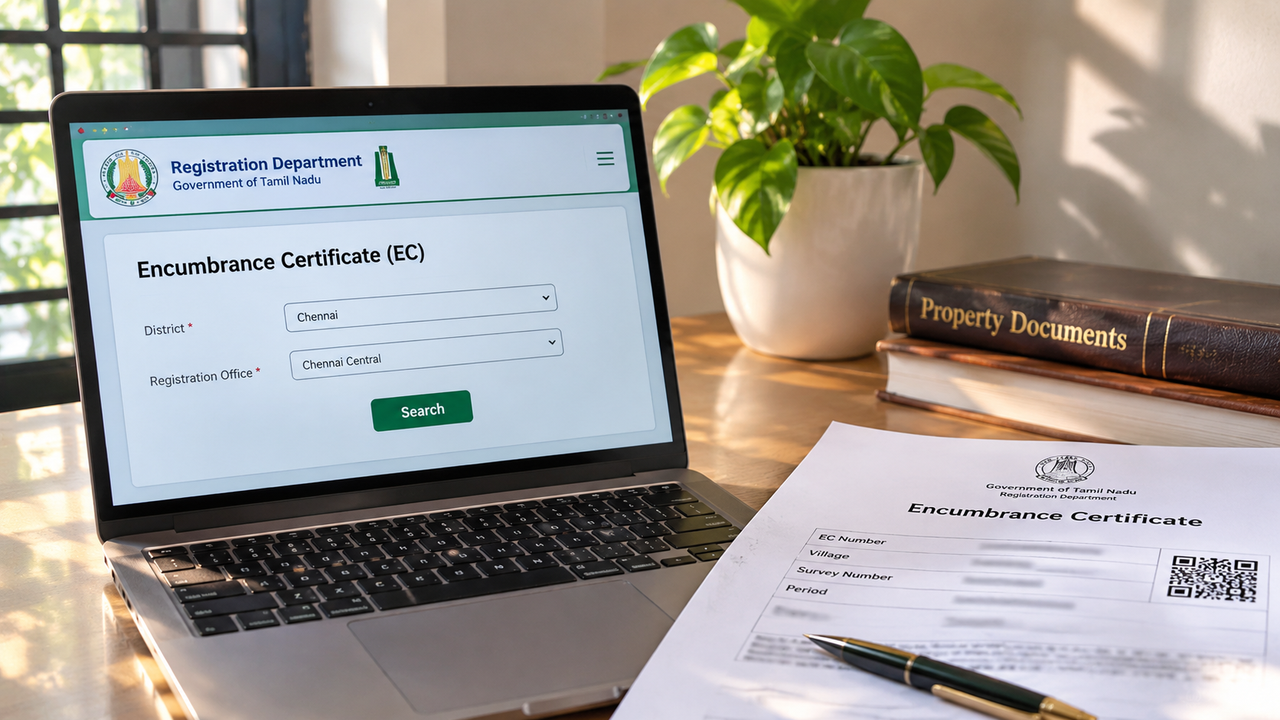
For any period from 1975 onwards, you can search and download the EC yourself on TNREGINET, the Tamil Nadu Registration Department's portal. Before you start, keep the survey number and subdivision, the village, the Sub Registrar Office and, if you have it, the document number of the latest deed.
On TNREGINET, open the E-services menu and choose Encumbrance Certificate. You will usually see the option to view an EC or to apply for a certified copy. Choose to search by property details, then enter the zone, district, Sub Registrar Office, village, survey number and subdivision. Next, enter the start and end dates for the period you need, complete the captcha and search. The results list every registered document for that property and period. You can usually view the details online, and a digitally signed copy is available for a small fee shown at the payment step.
It is worth running a second search by document number as well. Survey numbers are sometimes entered differently in older records, and a document number search is a good way to catch anything the first search missed.
How to Get an EC Offline at the Sub Registrar Office
For records before 1975, or if you would rather apply in person, go to the Sub Registrar Office where the property is registered. Fill in Form 22 with the property details and the period, attach a copy of a recent deed and your ID, and pay the fee. The office searches its registers and issues Form 15 or Form 16. Processing takes longer than online, so allow time, and keep the receipt to collect the certificate.
Which Period Should You Request?
This depends on why you need the EC. For a purchase or a home loan, ask for at least 30 years, so the EC covers the same period as your title search. For a patta transfer, the revenue office may ask for a shorter period, often around 13 to 15 years. If you are selling and a buyer has asked for an EC, ask what period their lawyer or bank wants before you apply.
If the oldest deed in your chain goes back further than 30 years, request from that date, so the EC and the deeds tell the same story. The planner below works out the period for you and tells you which part can be done online.
How to Read Your EC
Getting the EC is the easy part. Reading it properly is where it earns its keep. Lay it out next to your deeds in date order. Every sale in your chain should have a matching entry on the EC, with the same names, document numbers and dates. Every mortgage should be followed, later, by a release. And any entry you cannot match to a document is a question for the seller and your lawyer before you go further.
Pay particular attention to the end of the period. A mortgage taken in the last year or two, a lease that is still running, or a court attachment are the entries most likely to cause trouble on the day of registration. Our guide on how to check property title and parent documents explains how the EC fits into the wider title check.
Common Problems and How to Fix Them
EC searches do not always go smoothly. If your search returns nothing for a property you know has been sold, the survey number may have been entered differently, or the property may have been registered at a different Sub Registrar Office before jurisdictions changed. Try searching by document number, or check older survey numbers with the seller. If an entry shows the wrong name or extent, it may be a clerical error in the index; the Sub Registrar Office can advise on a correction. And remember that an EC only shows registered documents. It will not show an unregistered agreement to sell, a pending civil case or a family dispute, which is why the EC is one part of a title check and not the whole of it.
Whether you apply for an EC online or request a Villangam Certificate directly from the Sub Registrar Office, always verify that the search covers the correct property details and registration period.
What to Keep Ready Before You Apply
Having the right details in front of you saves most of the frustration with EC searches:
- Survey number and subdivision, exactly as on the latest deed
- Village, taluk and district
- Name of the Sub Registrar Office where the property is registered
- Document number and year of the latest deed, if known
- The start and end dates of the period you need
- ID proof and a copy of the deed, for an offline application
Using the EC in a Purchase
When you buy, plan on two ECs. The first, for the full 30 years, goes to your lawyer early on as part of the title check. The second, a fresh EC covering the last few months, should be checked just before registration, to make sure the seller has not mortgaged or sold the property since. Once the sale is registered, a new EC will show your purchase. Our guide to stamp duty and registration charges in Chennai covers the costs on the day of registration, and our comparison of resale vs new flats in Chennai explains why the EC matters even more for resale.
Ten Minutes That Can Save a Deal
An encumbrance certificate is one of the cheapest and quickest protections you have when dealing with property in Chennai. Get it for the right period, read it against your deeds, and refresh it just before registration.
Since 1995, RAPRO has helped more than 1,000 owners across 10+ countries buy, sell and manage property in Chennai, and we are rated 4.8 from 415+ reviews. Browse our current property listings, call +91 98410 50874, email enquiry@rajamproperty.in, or send us a message.

FAQ
Frequently asked questions
Everything you need to know about our consulting and AI solutions — from strategy to implementation.
Can I get an EC if I am not the owner?

Does an EC show unregistered agreements or court cases?
How long is an encumbrance certificate valid?
How do I get an EC for the period before 1975?
How many years of EC do I need when buying?
What is the difference between Form 15 and Form 16?
How do I get an EC online in Chennai?
What is an encumbrance certificate?