

Top 10 Commercial Property Consultants in Chennai (2026)
Buying Assistance
How to Check Property Title and Parent Documents in Chennai (2026)
Before you pay an advance on any Chennai property, trace who owned it, how it changed hands and whether anything is still owed on it. This guide walks through the parent documents, the online checks and the warning signs, with a free title chain checker.

Every year, people in Chennai lose money on property that the seller never had the right to sell. It is rarely dramatic fraud. More often it is a missing deed from the 1990s, a brother who never signed a release, a loan that was repaid but never formally closed, or a patta that still sits in a grandparent's name. Each of these can turn a dream purchase into years of legal trouble.
The fix is not complicated, but it does take patience. You need to see how the property came to the seller, check that every link in that chain holds, and make sure nobody else has a claim on it. This guide shows you how to check property title and parent documents in Chennai, step by step, with the documents to ask for, the online checks you can run yourself and the warning signs to watch for.
What Are Parent Documents, and Why Do They Matter?
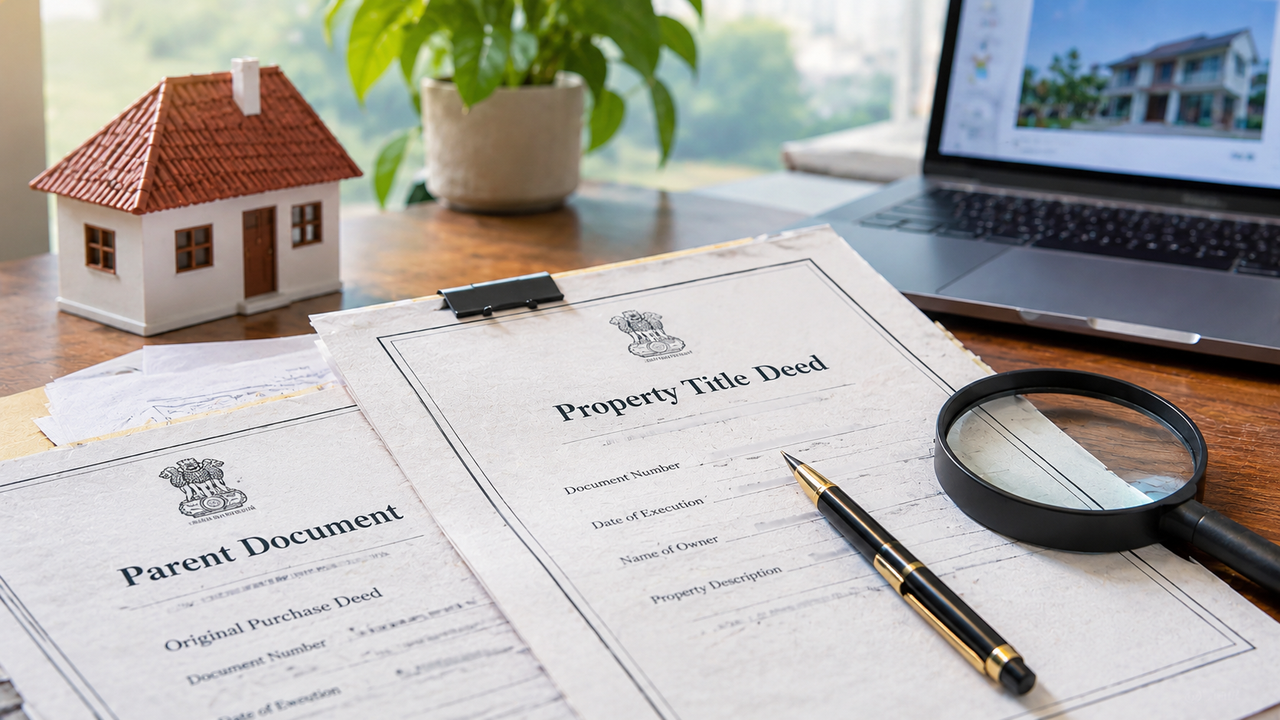
The sale deed in the seller's name tells you only the last chapter of the story. Parent documents, often called link documents or the mother deed, tell you the rest: who owned the property before, how it passed from one owner to the next, and whether each transfer was done properly. A property bought in 2015 may have been sold in 2003, inherited in 1996 and carved out of a larger plot in 1988. Each of those events should be backed by a registered document.
If any link is missing or flawed, the seller's title is only as strong as that weakest point. A buyer from a seller with a broken chain can find a former owner's heir turning up years later with a valid claim. That is why lawyers in Chennai typically trace title back at least 30 years, and why banks will not lend against a property until their own lawyer has done the same.
Step 1: Collect the Sale Deed and Every Link Document
Ask the seller for copies of the current sale deed and every earlier document in the chain. Depending on the property's history, that can include sale deeds, gift or settlement deeds, partition deeds, release deeds, wills with probate, and court decrees. If the seller cannot find an older deed, you can apply for a certified copy of any registered document on TNREGINET or at the Sub Registrar Office where it was registered.
Lay them out in date order. You should be able to read them like a story, with each document ending with the person who appears as the seller in the next one. The table below lists every document you are likely to need and what each one proves.
Step 2: Match the Chain, Line by Line
This is the part most buyers skip, and it is where most problems hide. Read each deed and check that the names of the buyer and seller match exactly from one document to the next, allowing for initials and spelling. The survey number and subdivision should stay the same, or change in a way another document explains, such as a subdivision of a larger plot. The extent should match too: if the 1996 deed transferred 2,400 square feet and the current deed says 2,600, you need to know why. Boundaries on all four sides should be consistent, and every deed should carry registration details, a document number and a stamp duty endorsement.
A small spelling difference is common and usually fixable with a rectification deed. A missing deed, an unexplained change in extent or a seller who appears without any document showing how they acquired the property are much more serious, and you should not proceed until they are resolved.
Step 3: Get an Encumbrance Certificate for the Full Period
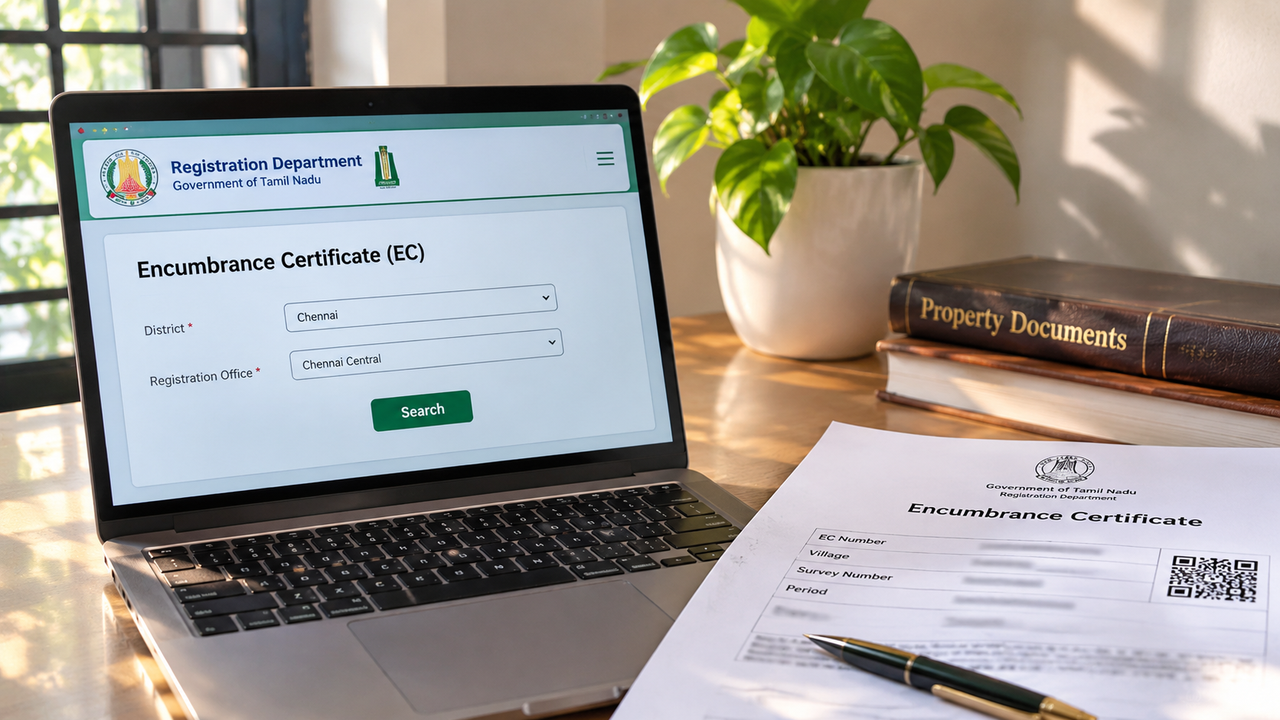
An encumbrance certificate, or EC, lists every registered transaction on a property over the period you ask for: sales, mortgages, releases, leases and court attachments. In Tamil Nadu you can apply online on TNREGINET, and records from 1975 onwards are available digitally. Request an EC that covers the same 30 years as your chain.
Read it alongside your deeds. Every sale in your chain should appear on the EC. Any mortgage should be followed by a release once the loan was repaid. Anything on the EC that you cannot match to a document is a question for the seller and your lawyer. Our guide on how to obtain an encumbrance certificate in Chennai explains the application step by step.
Step 4: Check Patta, Chitta and the Land Records
Registration records show who bought and sold the property. Revenue records show who the government recognises as owner of the land, and the two do not always agree. Use the Tamil Nadu e-services land records portal to check the patta and chitta by district, taluk, village and survey number. The patta should be in the seller's name, and the extent and classification should match the deeds.
The A register extract and the FMB sketch, the field measurement book drawing, confirm the land classification and its boundaries. Watch for land classified as government, poramboke, temple or wet agricultural land, which can carry restrictions on sale or construction.
Step 5: Verify Approvals and the Building Itself
A clean title on unapproved land or an illegal building is still a bad buy. For a plot, check that the layout is approved by the CMDA within the Chennai Metropolitan Area, or by DTCP outside it, and that the plot number appears on the approved layout. For a house or flat, ask for the approved building plan, and compare it with what is actually built: extra floors or enclosed balconies are a common deviation. For any building that is complete, ask for the completion certificate.
Finally, check that property tax and electricity bills are paid up to date and are in the seller's name. Unpaid dues can pass to the buyer, and up to date receipts are also useful evidence that the seller is actually in possession.
Step 6: Get a Written Legal Opinion
Even after all of this, have a property lawyer review the file and give you a written legal opinion before you pay an advance. A good lawyer will also search for pending court cases, check that any power of attorney used in the chain was valid, and confirm that every heir signed when the property passed through a family. Insist that the opinion states how many years it covers and lists the documents reviewed.
Use the checker below to see how complete your file is before you send it to the lawyer. It will also tell you which period to request on the EC.
Red Flags to Watch For
Most title problems in Chennai fall into a handful of familiar patterns. The table below lists the ones we see most often, what they usually point to and what to do about each.
Beyond the paperwork, be careful with a seller who refuses to show original documents, pushes for a large cash advance before you have checked the title, or wants the sale registered at an unusual Sub Registrar Office. Each of these has an innocent explanation now and then, but together they are a reason to slow down.
What to Ask the Seller For
When you first discuss the property, it saves time to ask for the full document set in one go. This is the list we give buyers:
- Current sale deed and all link documents for at least 30 years
- Encumbrance certificate for the same period
- Patta, chitta, A register extract and FMB sketch
- Approved layout or building plan, and the completion certificate
- Latest property tax receipt and electricity bill
- Legal heir certificate, will, release or settlement deed if the property was inherited
- Bank release deed if there was ever a loan on the property
When to Get Help
Checking title is part detective work and part legal judgment. If you are short on time, buying from outside Chennai, or simply want someone experienced to look over the file, RAPRO's buying assistance team can collect certified copies, coordinate with an independent property lawyer and walk you through the findings. Once you are ready to register, our guide to stamp duty and registration charges in Chennai shows exactly what you will pay. And if you are weighing an older home against a new one, our comparison of resale vs new flats in Chennai explains how the title checks differ.
A Clean Title Is Worth the Wait
Checking property title and parent documents can feel slow when you have found the right home and the seller is in a hurry. But a few weeks spent on the chain, the EC, the land records and a proper legal opinion protect what is likely to be the biggest purchase of your life.
Since 1995, RAPRO has helped more than 1,000 owners across 10+ countries buy, sell and manage property in Chennai, and we are rated 4.8 from 415+ reviews. Browse our current property listings, call +91 98410 50874, email enquiry@rajamproperty.in, or visit us at Twin Tower, 2nd Floor, TTK Road, Alwarpet.


FAQ
Frequently asked questions
Everything you need to know about our consulting and AI solutions — from strategy to implementation.
Does a bank loan approval mean the title is clear?

How much does a legal title check cost in Chennai?
Is an encumbrance certificate enough to prove title?
What if the original parent documents are lost?
How do I check patta and chitta online?
Can I check a sale deed online in Tamil Nadu?
How many years of title should I check in Chennai?
What are parent documents in property?