

Top 10 Commercial Property Consultants in Chennai (2026)
Buying Assistance
Stamp Duty and Registration Charges in Chennai (2026)
Buying property in Chennai? See the 2026 stamp duty and registration charges for resale and new flats, houses and land, family transfers and power of attorney, with worked examples and how to pay.

Ask anyone who has bought a home in Chennai what surprised them most, and you will often hear the same answer: the money they had to find on registration day. The price you negotiate is only part of the story. Stamp duty and the registration fee sit on top of it, and on an ₹80 lakh flat they can easily add another ₹7 lakh.
The rules have also changed more in the last three years than in the decade before. New flats moved to a single composite sale deed in December 2023, the registration fee came down to 2%, power of attorney charges went up sharply in May 2024 and women buyers got a registration concession in April 2025. A lot of what you read online has not caught up.
This guide sets out the current stamp duty and registration charges in Chennai, how the guideline value decides your bill, what you pay on family deeds and power of attorney, and how to pay online. There is a calculator further down so you can work out your own number in a few seconds.
Stamp Duty and Registration Charges in Chennai: The 2026 Rates
Tamil Nadu charges two separate levies when you register a property. Stamp duty is a tax on the transaction itself, collected under the Indian Stamp Act. The registration fee is what the Registration Department charges to record the document under the Registration Act, 1908. Both are paid before your sale deed is registered at the sub-registrar office (SRO), and both are worked out as a percentage of the property's value.
The rate you pay depends on what you are buying and who you are buying it from. Here is the full picture for 2026.
Every percentage in that table applies to the higher of two numbers: the price written in your sale deed and the government guideline value. We will come back to that, because it catches out more buyers than anything else. Before you register, it is always worth confirming the live rates on TNREGINET, the Registration Department's portal.
Stamp Duty vs Registration Fee: What Is the Difference?
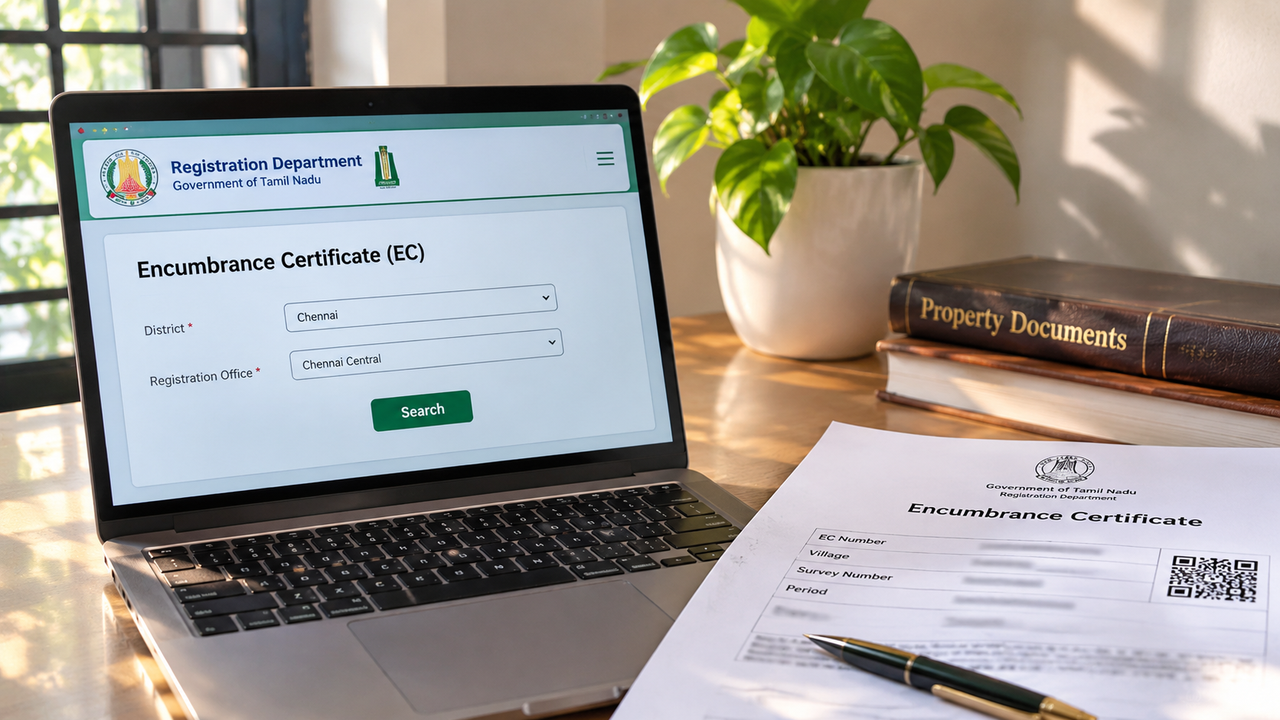
People tend to use the two terms interchangeably, and in practice you pay them together, but they are different things. Stamp duty is the larger of the two. At 7% on a resale property, it is the state's tax on the transfer of ownership, and you can pay it through e-stamping or online on TNREGINET. The registration fee, now 2% on a sale deed, is the charge for entering your document into the government's records. Once it is paid and the deed is registered, the transaction becomes part of the public record and will show up in the property's encumbrance certificate.
Neither one attracts GST. GST only comes into the picture when you buy a flat that is still under construction, and that is a separate 5% on the price, which we cover later.
How the Guideline Value Decides What You Pay
Every street and survey number in Tamil Nadu has a guideline value: a minimum rate per square foot fixed by the Registration Department. When you register, the sub-registrar compares it with the price in your sale deed and charges stamp duty and registration on whichever is higher.
That has two practical consequences. If you agree to a price below the guideline value, perhaps because the seller is in a hurry, you still pay duty as if you had paid the full guideline value. And if your price is above it, which is common in sought-after parts of the city, you pay on your actual price. Showing a lower figure on paper does not save you anything, and it can create problems with the bank and the tax department later.
You can check the guideline value yourself on TNREGINET by district, sub-registrar office, village and survey number or street name. It takes a couple of minutes and gives you a firm floor for your budget before you even start negotiating.
New Flats and the Composite Value System
Until November 2023, buying a new flat in Chennai meant registering two documents: a sale deed for your undivided share of land (UDS) and a separate construction agreement with the builder. Since 1 December 2023, the first sale of a new flat or villa by a builder or landowner is registered through a single sale deed based on a composite value that covers both the land share and the building (DT Next).
The state also lowered the stamp duty for these first sales. A new flat up to ₹50 lakh now attracts 4% stamp duty, one between ₹50 lakh and ₹3 crore attracts 5%, and anything above ₹3 crore pays the full 7%. With the 2% registration fee, most buyers of new homes in Chennai pay 6% or 7% in total rather than 9%.
The concession applies only to the first sale. When that same flat is sold again, the next buyer pays the standard 7% plus 2%. If you are weighing the two options, our guide to resale vs new flats in Chennai runs the numbers side by side.
Work Out Your Own Stamp Duty and Registration Charges
Use the calculator below to estimate what you will pay. Pick the type of property, enter the agreed price and, if you have it, the guideline value. Tick the boxes if the property is being registered in a woman's name or if the flat is still under construction.
To give you a feel for how it plays out, take an ₹80 lakh resale flat in Velachery with a guideline value of ₹70 lakh. Duty is charged on the ₹80 lakh price, so stamp duty comes to ₹5.6 lakh and registration to ₹1.6 lakh, a total of ₹7.2 lakh. Buy a new ₹80 lakh flat from a builder on OMR instead and the bill drops to ₹5.6 lakh, although you would add ₹4 lakh of GST if the flat is not yet complete. A plot in Medavakkam agreed at ₹40 lakh but with a guideline value of ₹50 lakh costs ₹4.5 lakh to register, because duty follows the higher guideline figure.
Stamp Duty on Family Deeds, Power of Attorney and Rental Agreements
Not every property transfer is a sale, and Tamil Nadu treats transfers within a family very differently from transfers to outsiders. A settlement or gift deed to a family member costs just 1% stamp duty, capped at ₹40,000, plus 1% registration capped at ₹10,000. Partitions and releases between family members follow the same pattern. Give the same property to a friend or a distant relative who does not count as family, and you are back to the full 7% plus 2%.
In Tamil Nadu, family generally means a spouse, children, grandchildren, parents, grandparents, brothers and sisters. Since 2024 it also includes the legal heirs of a family member who has died, which helps families sorting out inherited property.
The biggest change for owners came on 3 May 2024, when the state raised stamp duty on a long list of documents (DT Next; Legal 500). A power of attorney given to a family member now costs ₹1,000. One given to a non-family member to deal with immovable property costs 1% of the property's market value, which on a ₹1 crore flat is a full ₹1 lakh. This hits NRIs hardest, because many rely on a power of attorney to buy, sell or manage property in Chennai. Wherever you can, give it to a family member. Our NRI property buying checklist walks through the alternatives.
Concessions That Can Lower Your Bill
There are only a handful of ways to pay less, and they are worth knowing. Since 1 April 2025, a property worth up to ₹10 lakh that is registered in a woman's name gets a 1% reduction in the registration fee (DT Next). It covers houses, plots and agricultural land, and on a ₹9 lakh plot it saves ₹9,000.
Buying new rather than resale is the bigger lever for most families, because the composite rates take the total down to 6% or 7% for homes up to ₹3 crore. And if you registered a construction agreement under the old system, the stamp duty you paid on it can be set off against the duty due on your final sale deed. Take the registered agreement and the payment proof to the sub-registrar office and ask for the adjustment.
On the tax side, stamp duty and registration on a home you buy can be claimed under Section 80C if you are on the old tax regime, within the overall limit for that section. Speak to your chartered accountant about whether it makes sense for you.
Other Costs to Budget For
Stamp duty and registration are the biggest add-ons, but they are not the only ones. Under-construction flats and villas attract 5% GST on the price (1% for affordable housing), while ready-to-move and resale homes attract none. If the property costs ₹50 lakh or more, the buyer deducts 1% TDS from the payment to a resident seller and pays it to the government. That is part of the price rather than an extra cost, but it needs to be planned for. If the seller is an NRI, the TDS rate is far higher, as our NRI property tax guide explains. Add legal fees for the title search and drafting, and a small amount for the patta transfer and utility name changes after registration.
How to Pay Stamp Duty and Register Property in Chennai
Most of the process now starts online. Begin by checking the guideline value on TNREGINET, then have your lawyer draft the sale deed using the higher of the price and the guideline value. You create the document on TNREGINET, pay the stamp duty and registration fee online or through an authorised bank, and book a time slot (a token) at the sub-registrar office that covers the property's area.
On the day, the buyer, the seller and two witnesses go to the sub-registrar office. Photographs and fingerprints are taken there, the sub-registrar checks the documents, and the deed is registered. Remember that a signed document should be presented for registration within four months. Here is what to carry so the visit goes smoothly:
- The original sale deed, ready for signing, and the e-stamp or payment receipt
- The original title deed and parent documents from the seller
- A recent encumbrance certificate and the patta
- Photo ID and address proof for the buyer, the seller and both witnesses
- PAN cards for the buyer and seller
- A power of attorney, if someone is signing on the owner's behalf
- The TDS payment proof, if the property costs ₹50 lakh or more
Once the deed is registered, apply for the patta transfer and update the property tax and electricity records into your name. Buying a flat, a house or land? Our guides to flats for sale in Chennai, houses and villas for sale in Chennai and land for sale in Chennai cover what to check before you get this far.
Can You Get a Refund on Stamp Duty?
Sometimes a deal falls through after you have already bought stamp paper or paid the duty. In that case you can apply to the District Registrar for a refund of unused or spoiled stamps under the Indian Stamp Act. Apply as soon as you can with the original stamp papers and proof of payment, because refunds have strict time limits and a small deduction is made. Once a document has been registered, the duty is generally not refundable.
Get Your Registration Right the First Time
Stamp duty and registration add 6% to 9% to the price of most homes in Chennai, and the rules change often enough that last year's figures can mislead you. Check the guideline value early, use the right rate for your type of property and build the full cost into your budget from day one.
Since 1995, RAPRO has helped more than 1,000 owners across 10+ countries buy, sell and manage property in Chennai, and we are rated 4.8 from 415+ reviews. Our buying assistance team handles the paperwork, payments and registration for you, including for NRIs who cannot be in Chennai, and our selling assistance team does the same for sellers. Call +91 98410 50874, email enquiry@rajamproperty.in, or visit us at Twin Tower, 2nd Floor, TTK Road, Alwarpet. You can also send us a message.

FAQ
Frequently asked questions
Everything you need to know about our consulting and AI solutions — from strategy to implementation.
How long do I have to register a sale deed after signing it?

Can I include stamp duty in my home loan?
How much does a power of attorney cost in Tamil Nadu?
How much is stamp duty on a settlement deed to a family member?
Is there a stamp duty concession for women in Tamil Nadu?
Is stamp duty charged on the guideline value or the sale value?
How much stamp duty do I pay on a second-hand flat in Chennai?
Is the registration fee in Tamil Nadu 2% or 4%?
What are the stamp duty and registration charges in Chennai in 2026?