

Deep Cleaning vs Regular Cleaning: What’s the Difference? (2026)
Repair and Maintenance
What Goes Wrong in a Vacant Flat, and How NRIs Can Prevent It (2026)
An empty flat does not stay the way you left it. Slow leaks run unnoticed, drains dry out, mould grows in closed rooms, fittings seize and bills keep coming. Here is what typically goes wrong in a vacant flat in Chennai, a visit routine that prevents it, and a calculator for the real cost of keeping a flat empty.

Many NRI owners leave a Chennai flat closed between tenants, between visits home, or while they decide whether to sell. The plan is always the same: lock it, ask a relative to look in now and then, and come back to find it just as it was. It rarely works out that way. A home is built to be lived in, and when nobody is there, small problems grow quietly for months.
This guide covers what typically goes wrong in a flat left empty in Chennai, why each problem happens, the visit routine that prevents most of them, the bills that keep running while the flat earns nothing, and a calculator to see what an empty flat is really costing you.
Why Empty Homes Deteriorate Faster
A lived-in home gets small, constant attention without anyone noticing. Taps run every day, so water stays fresh in the pipes and drain traps. Windows open, fans turn and air moves. Someone sees the first drip, the first stain, the first line of ants. Take that away, and every small problem has months to grow before anyone sees it.
Chennai adds two pressures. The humidity, which stays high for much of the year, feeds mould in closed rooms and wardrobes. And the northeast monsoon, from October to December, can send water through a terrace crack or window frame into a flat where nobody will see it until the ceiling stains. Our post-monsoon home checklist covers the damage the rains leave behind, and it is most needed in homes nobody lives in.
What Goes Wrong, and How to Prevent It
These are the problems we find most often when we open a flat that has been closed for several months.
Two of these surprise owners most. The first is the smell. Every sink, shower and floor drain has a trap, a bend that holds water and blocks sewer gas. In an empty flat, that water evaporates within weeks, and the smell, along with cockroaches, comes up through the dry drain. Running every tap for a minute on each visit refills the traps. The second is mould. In a closed flat, mould can spread across walls and through wardrobes in a single monsoon; our guide on why mould keeps coming back explains how to deal with it once it starts.
A Visit Routine That Works
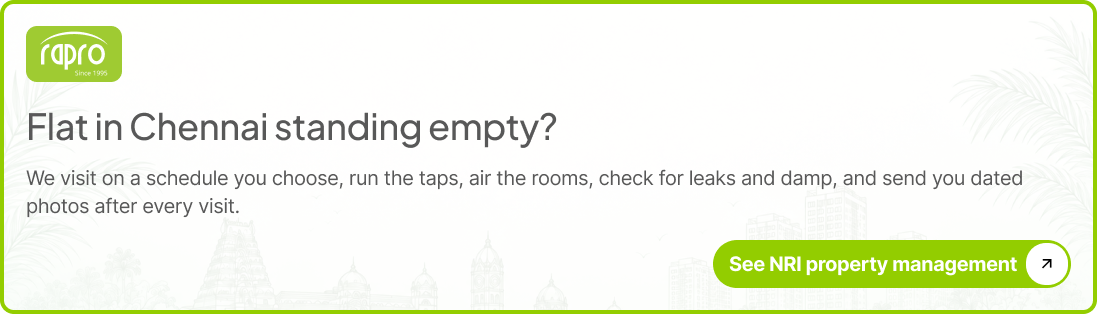
The single most effective protection for an empty flat is a regular visit with a fixed routine and a dated photo record. A relative popping in now and then helps, but a routine done the same way every time catches problems that a quick look misses.
Before you leave the flat for a long period, set it up so the visits are easy and the risks are lower:
- Close the main water valve and switch off the geysers and unused circuits
- Empty and clean the fridge, or leave it running with the door secured
- Remove food, and leave cupboard doors slightly open to let air move
- Pay property tax, maintenance and utility bills online, with reminders
- Leave a spare key and the society office number with whoever will visit
- Photograph every room, so later damage can be compared against a baseline
A Worked Example: One Year Empty
Here is a pattern we see often, with typical figures. An owner in Singapore keeps a 2 BHK in Velachery empty for a year after a tenant leaves, planning to move back. A cousin visits twice in that year. The flat costs ₹3,500 a month in society maintenance, around ₹400 a month in electricity and water minimums, and ₹6,000 a year in property tax: about ₹52,800 for the year before anything goes wrong.
Then the monsoon arrives. A blocked terrace outlet sends water into a crack above the second bedroom, and by the time anyone notices, three months later, the ceiling plaster has to be scraped back and redone, the wall repainted, and the wardrobe on that wall, its back panel swollen and mouldy, replaced. The bathroom traps have dried out, so the flat smells of drains and has a cockroach problem that needs treatment. Two taps have seized and a geyser valve has corroded. None of it is dramatic on its own. Together, it is several weeks of work and a repair bill that can run well beyond the year’s maintenance charges, plus a lost month before the flat is fit to live in.
The same flat with a visit every three weeks would have shown the damp patch within days of the rain, when the fix was clearing a drain and sealing a crack. That is the whole case for a routine: not that problems never happen, but that they are found while they are small.
Security and the Society
An empty flat is easier to spot than people think: no lights in the evening, a pile of flyers at the door, a dusty car in the parking. Tell the society office and the security team that the flat will be empty and who is authorised to visit, keep a record of every visit, and have the person who visits clear the doorstep and check the locks each time. Keep copies of keys to a minimum and know who holds each one.
The Bills Keep Running
An empty flat still costs money every month. Property tax is due to the Greater Chennai Corporation whether or not anyone lives there. Society maintenance continues, and electricity and water accounts with TNEB and Chennai Metrowater carry their own charges. If you leave a home empty for long periods, check your home insurance too: some policies set conditions for homes left unoccupied, and the regulator, IRDAI, publishes guidance for policyholders on reading policy terms.
Then there is the rent the flat could be earning. Use the calculator below with your own figures to see the full cost of keeping it empty for a year.
Empty, Rented or Managed?
Some owners keep a flat empty on purpose: for family visits, a planned return, or a sale. For them, a visit routine and a home AMC keep the flat in shape, so it is ready when they need it. Our NRI home maintenance service combines scheduled visits, repairs approved by you, and photo reports after every visit.
For many others, the better answer is to let the flat. A tenant keeps it aired and watched, reports problems early and pays rent instead of the flat only costing money. The usual worry is the tenant. Verification, a registered agreement and a photo move-in inspection deal with most of that, as our case study on an NRI tenant move-out shows. And if the flat has been empty because the last tenant left and the search stalled, our guide to immediate rental placement explains how to fill it in weeks rather than months. Our property management in Chennai handles the whole cycle for owners in 10+ countries.

An Empty Flat Needs a Routine
A closed flat does not stay the way you left it. Leaks run, drains dry, mould spreads and bills keep coming. A visit every few weeks with a fixed routine and dated photos prevents most of it, and a check after every monsoon catches the rest. Or let it, and have it managed, so it earns while it is looked after.
Since 1995, RAPRO has looked after homes for more than 1,000 owners across 10+ countries, and we are rated 4.8 from 415+ reviews. Call +91 72999 14181, email enquiry@rajamproperty.in, or send us a message.
FAQ
Frequently asked questions
Everything you need to know about our consulting and AI solutions — from strategy to implementation.
Is it better to rent out a flat than keep it empty?

Does home insurance cover a vacant flat?
Do I still pay property tax and maintenance on an empty flat?
Should I turn off the water and power in an empty flat?
How often should a vacant flat be checked?
What happens to a flat that stays locked for a long time?